Home › Guides › The Wrestling Competition Guide
The Wrestling Competition Guide
The only combat sport that weighs you in the middle of the tournament. Most of what goes wrong happens in the hours between the two scales.
What is inside
- The day-two tolerance table, and where the 2 kg allowance does not exist
- The overnight problem: what the evening between the weigh-ins has to contain
- The day-one margin that makes a normal evening possible
- Which rulebook governs you, and what the American minimum weight programme does
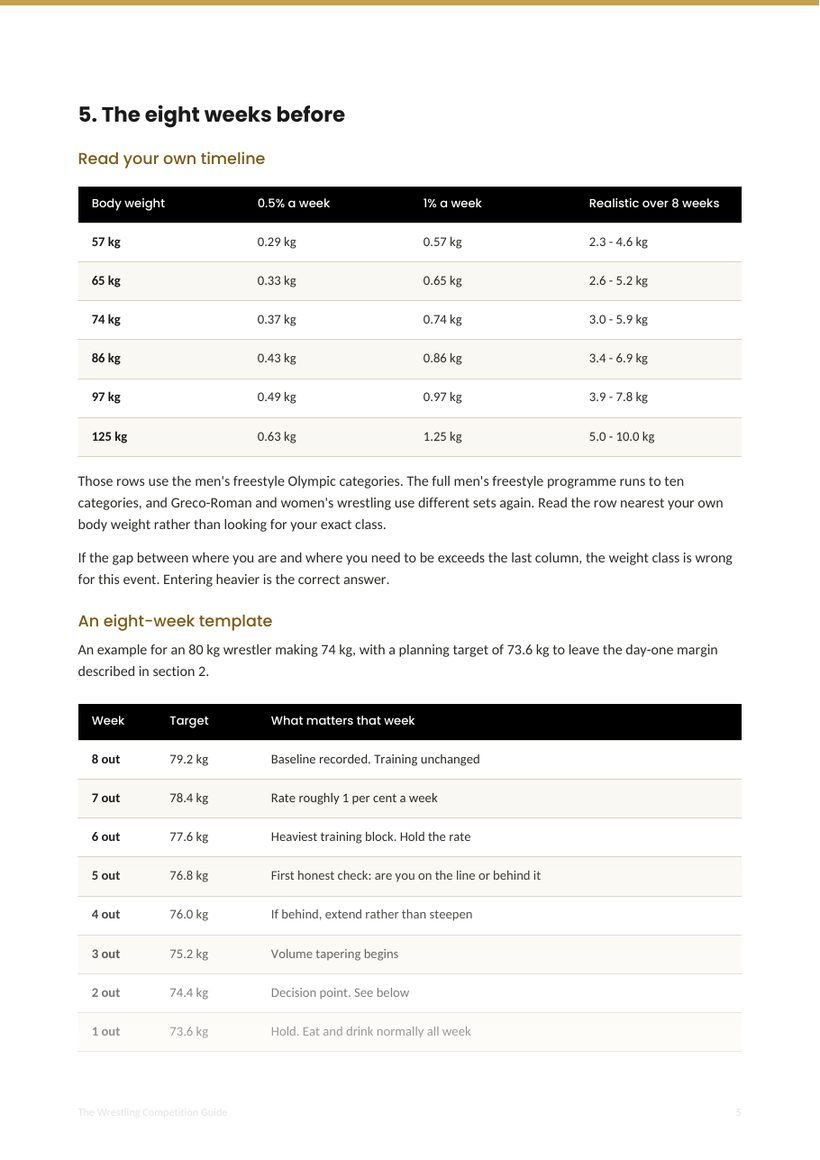
- A timeline table and an 8-week template with a target for every week
- Day one and day two, including why the medal bouts are wrestled least fresh
- A tournament card and a bag checklist
You buy it once, you download the PDF, it is yours. No email course, no coaching call attached, no upsell. Refund terms.
Who it is for
- A wrestler competing in a tournament with a second weigh-in the next morning.
- A coach who needs the day-one margin planned so the evening is normal.
- Anyone competing under a rulebook with a tolerance that is not the same on both days.
Who it is not for
- An athlete under 18 looking for a way down a class. Scholastic wrestling sets a minimum weight through certification, and that material is free in how to cut weight for wrestling.
- A parent looking for a weight-loss plan for a child.
- A fighter with a single day-before weigh-in.
Before you buy
Two complete documents are free to read on the samples page, and the reasoning behind this guide is on the site at no cost. If the free pages answer your question, you do not need it.
Common questions
Does it cover the second weigh-in?
Yes. Most of what goes wrong happens in the hours between the two scales.
Which rulebook does it follow?
It sets out which rulebook governs you and where the tolerance differs. Confirm the current rules with your own association.
Is it for high school wrestlers?
The certification rules that govern school wrestling are covered free on the site instead, and they set the floor before anything else.
Is there an 8-week template?
Yes, with a target for every week.
Does it include a tournament card?
Yes, along with a bag checklist.
Free reading on the same problem
The guide is the protocol. These articles are the reasoning behind it, and they cost nothing.
- Wrestling: The Second Weigh-In Decides It. Making weight on day one is not the job. At championship level the second morning carries no tolerance, and 2 kg only at Ranking Series and World Cup.
- How to Cut Weight for Wrestling, Safely: Certification First. Certification sets a wrestler's minimum class through a hydration test and body fat assessment, and caps descent at 1.5% a week. How to work inside it.
- Wrestling Weight Classes: School, College and International. NFHS lets each state choose, the NCAA runs 10, and United World Wrestling runs 10 per style. All of them, plus the rule that caps how far down you may go.
- NCAA Wrestling Weight Classes and the Certification Rules. The 10 men's and 10 women's NCAA classes, the 1 November certification deadline, the descent plan, and what happens when a wrestler moves up.
- Best Supplements for Wrestling: Evidence and the Rules. Supplements with evidence for wrestlers, what an NCAA school can hand out, the caffeine limit in college testing, and why high schoolers start with food.
- Hydration Testing: What 1.025 Actually Measures. The same threshold is used in two sports for opposite purposes. One uses it to let you compete, the other to decide how light you are allowed to get.
The guides are the system in general. If you want the numbers run for your weight, your date and your weigh-in format, that is a written plan, which is a different product from a guide.
The monthly email is sent through Substack, and its sign-up page opens in a new tab. Subscribing is optional, and every email has a one-click unsubscribe link. See the privacy notice.
Oleksandr Foka — sports nutritionist. Guides are sold and delivered through Gumroad, under their terms.
Educational material, not medical treatment. For adults 18+. Weight cutting carries real risks including dehydration, electrolyte imbalance, impaired cognition and cardiac strain. Nothing here replaces care from a physician. Under strict liability, final responsibility for anything you take is yours.