Home › Guides › The BJJ Competition Guide
The BJJ Competition Guide
You weigh in shortly before your first match, in your gi, with one attempt. There is no recovery window, so a cut is paid for on the mat.
What is inside
- Why the weight cut has no upside in this format
- A uniform weight table by weave and size, and the kit arithmetic that decides your division
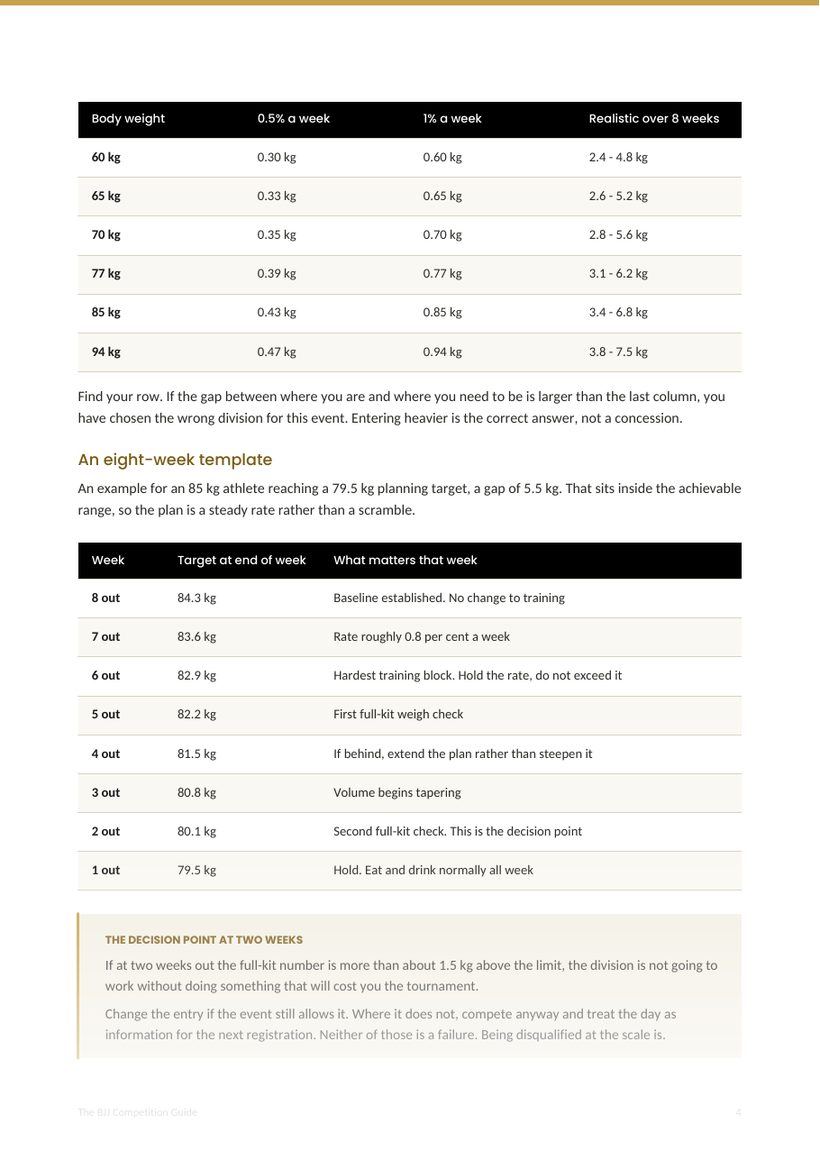
- A timeline table for six body weights and a full 8-week template
- The 2-week decision point that tells you whether the division will work
- Between matches: a three-band structure in millilitres and grams
- When something goes wrong: marginal at the venue, two divisions in a day, gi and no-gi across a weekend
- A one-page competition day card
You buy it once, you download the PDF, it is yours. No email course, no coaching call attached, no upsell. Refund terms.
Who it is for
- A competitor weighing in shortly before the first match, in the gi, with one attempt.
- Anyone deciding between two divisions and unsure whether the kit arithmetic makes the lower one possible.
- Someone competing gi and no-gi across the same weekend.
Who it is not for
- A fighter with a day-before weigh-in and a recovery window. That is a different job.
- Anyone after a fat-loss plan.
- An athlete under 18 looking for a way down a division.
Before you buy
Two complete documents are free to read on the samples page, and the reasoning behind this guide is on the site at no cost. If the free pages answer your question, you do not need it.
Common questions
Does it include a uniform weight table?
Yes, by weave and size, because in this format the gi is part of the number on the scale.
Can I cut for a BJJ competition?
The guide sets out why a cut has no upside when you weigh in minutes before you compete, and what to do instead.
Does it cover two divisions in one day?
Yes, along with what to do when the venue scale reads marginal.
Is there a plan for the gaps between matches?
Yes, as a three-band structure in millilitres and grams.
Which rules does it follow?
The formats used by the main federations are compared. Confirm the current rules with the organiser of your event.
Free reading on the same problem
The guide is the protocol. These articles are the reasoning behind it, and they cost nothing.
- BJJ Weight Cutting: Why It Cannot Work. Under IBJJF rules you weigh in shortly before your first match, in your gi, with one attempt. No recovery window, so a cut is paid for on the mat.
- BJJ Weight Classes: IBJJF and ADCC, Gi and No-Gi. IBJJF gi and no-gi limits and the ADCC sets, plus the two rules that make jiu jitsu different: the gi counts, and you weigh in minutes before you compete.
- Best Supplements for BJJ: What Works With No Recovery Window. The supplements with evidence for BJJ, USADA testing at IBJJF majors, and why a weigh-in in the gi right before the match changes everything.
- What to Eat Between Matches at a Tournament. Twenty minutes between bouts or 2 hours. The structure that works for both, and the weigh-in that comes back tomorrow morning.
- Weigh-In Rules by Sport: The Reference Table. Every combat sport weigh-in rule in one place: when you weigh, what is checked, what tolerance exists, and what happens if you miss. Sourced and dated.
- Your First Weigh-In: Read This Before You Cut. For a first competition, the answer is almost always to compete at what you weigh. No data on yourself yet, and the first event is where you get it.
The guides are the system in general. If you want the numbers run for your weight, your date and your weigh-in format, that is a written plan, which is a different product from a guide.
The monthly email is sent through Substack, and its sign-up page opens in a new tab. Subscribing is optional, and every email has a one-click unsubscribe link. See the privacy notice.
Oleksandr Foka — sports nutritionist. Guides are sold and delivered through Gumroad, under their terms.
Educational material, not medical treatment. For adults 18+. Weight cutting carries real risks including dehydration, electrolyte imbalance, impaired cognition and cardiac strain. Nothing here replaces care from a physician. Under strict liability, final responsibility for anything you take is yours.